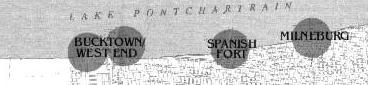
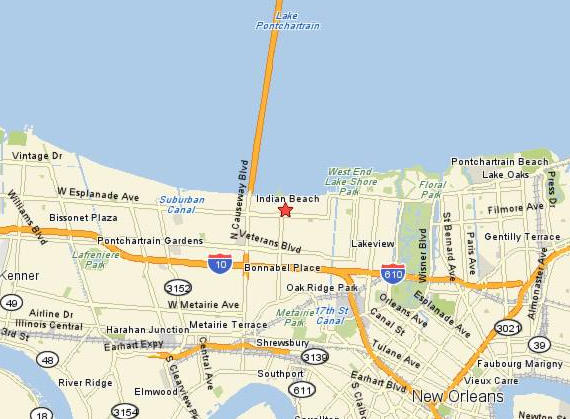
Spanish Fort is located near Robert E. Lee Blvd. and Bayou St. John. This was where the lakeshore began before the massive land reclamation project during the 1920s & 30s which resulted in subdivisions and Lakeshore Drive.
When the fort was no longer needed, the land was sold to an amusement park vendor who renamed it Spanish Fort. Later this became the 1st location of Pontchartrain Beach Amusement Park. Because of this, many old timers called Fort St. John/Spanish Fort "The Old Beach".
Over the years, Spanish Fort changed hands quite a few times. There were also lawsuits disputing its ownership, so it may be somewhat difficult to easily explain who owned it throughout its history as a recreation area. I'm afraid I can't provide details about ownership of the park rides since amusement rides were not as well-documented as real estate. Quite often, rides were owned by out-of-town investors but operated by local people.
I've observed that popular amusement places tend to be among the most poorly documented historic sites. I think people just took them for granted, rarely saving photos or otherwise documenting facts concerning the places where they enjoyed their leisure hours. Unless more people who remember the old parks and theaters share their memories with others, firsthand information about those places will be forever lost.
In 1823, by a special act of Congress, Harvey Elkins purchased the Spanish Fort site. Within two years, Elkins had built a hotel on the site, thus beginning Spanish Fort's century-long reputation as a popular resort. It didn't take long to attract international attention. In 1828, his highness Bernhard, Duke of Saxe-Weimar-Eisenach, published both English and German editions of his Travels through North America, during the years 1825 and 1826. In this narrative, Duke Bernhard mentions traveling through the Rigolets and Lake Pontchartain, noting that a tavern was then being erected at the site of the old Spanish fort on Bayou St. John.
Ownership soon passed from Elkins to John Slidell; later, the New Orleans City and Lake Railroad would own the site before selling it, in 1877, to Moses Schwartz. It was Schwartz who first developed the amusement park that operated at Spanish Fort until the late 1920s. New Orleans Public Service would own the property before, in 1937, turning it over to the Orleans Parish Levee Board.
Before 1900, Spanish Fort was especially famous for its opera house and fine seafood restaurants. Author William Makepeace Thackeray and Gen. Ulysses S. Grant were among the celebrities who dined at Spanish Fort and later bragged about the experience. In the early 1880s, during his great American tour, playwright Oscar Wilde lectured a Spanish Fort audience about household beauty.
During its heyday as an amusement park, from the 1880s to the 1920s, Spanish Fort faced stiff competition from its nearby rival, West End. Although Spanish Fort had brief moments of grandeur, sometimes proclaiming itself to be the "Coney Island of the South," the flood-prone park frequently fell on hard times, while West End prospered. In 1903, streetcar service to the park was discontinued. Ownership passed to the same streetcar company that operated the rival park, but Spanish Fort would never attain West End's fame or grandeur. Spanish Fort closed in 1926.