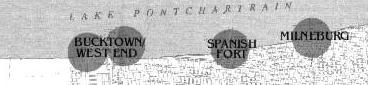
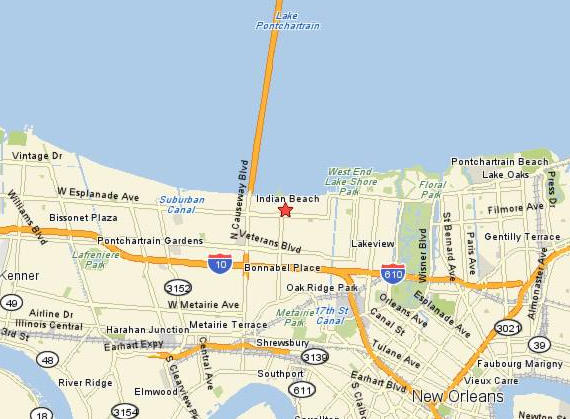
Development along this area originally occurred in the mid-19th century with a commercial wharf and resort called Lakeport. Steamboats docked at the entrance to the New Basin Canal (now Pontchartrain Blvd.) and at the terminus of the Jefferson and Lake Pontchartrain Railroad where Bucktown is today. The railroad ran along what is now the Orleans-Jefferson Parish boundary at the 17th Street Canal. Dug as a drainage canal along the upper boundary of the Town of Carrollton, it was originally called the Upperline Canal.
During the days of Prohibition, Bucktown was known for its speakeasies, houses of prostitution, and gaming dens. Gambling was legal in what was known as 'the free State of Jefferson.' Bucktown was a rowdy, wide-open place where the barroom brawls were common. The settlement is said to have been named for the young bucks who came there looking for a rough time. There are other stories about the origin of the name. Some say that the village was named for the good deer hunting in the area. Others say it was named for a local fisherman, Oliver 'Buck' Wooley.
Amid the unrestrained gaiety, Bucktown was one of the places where jazz was born with such tunes as the 'Bucktown Bounce' by Johnny Wiggs and the 'Bucktown Blues' by Jelly Roll Morton.
Bucktown was exposed to violent storms and the resulting damage contributed to its picturesque, ramshackle appearance. The fishing village survived the hurricanes of 1915 and 1947, as well as the encroachment of urban suburbs.
Until the recent years, the 17th Street Canal at Bucktown was home to a fleet of about one hundred shrimp boats. Yearly on the 4th of July, a festival was held for the Blessing of the Fleet. Through the years Bucktown remained a center where fresh seafood could bought from local fisherman.