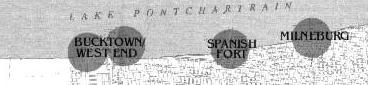

Much of the remaining area of the Planning District was held by Alexander Milne, a Scottish footman who arrived in America just before 1776 and acquired his fortune from first a hardware business and later brick making. Although he believed New Orleans would grow toward the lake, little was possible until the Pontchartrain Railroad became a reality in 1831. The railroad connected Lake Pontchartrain to the Vieux Carr, (along present-day Elysian Fields Avenue) and developed Milneburg Port at its terminus. While the port handled cargo from Mobile,
the surrounding land soon became a resort area, initially with the Lake House tavern and Washington Hotel. Three bathhouses, other hotels and restaurants, camps, and saloons soon followed. Eventually, the name Milneburg connoted a resort area rather than an industrial port.
1831-the Pontchartrain Railroad made Milneburg its lake-end terminal and added to its fame as a resort.
1839-The town of Milneburg consists of a few houses, the Washington and Arch Hotels, a grocery, two barrooms and a bakery. It was named for Alexander Milne, a Scottish philanthropist who owned much of what is now the New Orleans Lakefront.
The Milneburg pier was later built with many camps that could be rented for parties. Black musicians, bands and jazz flourished there.
1930s-the popularity of Milneburg began to wane as the West End and Pontchartrain became big attractions. The development of a seawall along the lake, prohibition and the last run of Smokin' Mary in 1932 signaled the end of the village and in 1934 a fire destroyed all that remained.
Much of the remaining area of the Planning District was held by Alexander Milne, a Scottish footman who arrived in America just before 1776 and acquired his fortune from first a hardware business and later brick making. Although he believed New Orleans would grow toward the lake, little was possible until the Pontchartrain Railroad became a reality in 1831. The railroad connected Lake Pontchartrain to the Vieux Carr, (along present-day Elysian Fields Avenue) and developed Milneburg Port at its terminus. While the port handled cargo from Mobile, the surrounding land soon became a resort area, initially with the Lake House tavern and Washington Hotel. Three bathhouses, other hotels and restaurants, camps, and saloons soon followed.
Eventually, the name Milneburg connoted a resort area rather than an industrial port.
The port declined during the Civil War with the suspension of trade with Mobile, Alabama. In 1870, the port declined further when it lost much of its cargo to the New Orleans, Mobile and Chattanooga Railroad. The area evolved into an entertainment district, as the city's passenger train, the Smoky Mary, began carrying more middle-class visitors to the resort. Entertainment included jazz, with Sidney Bechet, Louis Armstrong and Danny Barker performing. Milneburg closed in 1930 after the development of a seawall that displaced several buildings in the resort. The site became the Pontchartrain Beach Amusement Park and the surrounding reclaimed land for the Lake Terrace/Lake Oaks neighborhood.
Over the next 35 years several residences were developed within the filled area. These neighborhoods were developed with deed restrictions imposed by the Levee Board. Lake Terrace, opened in 1953, contained 440 residential lots and 93 acres of park space in the area bounded by Lake Pontchartrain, London Avenue Canal, Robert E. Lee Boulevard and Bayou St. John. In 1964 the last development was completed, Lake Oaks, in the area bounded by Elysian Fields, Music Street and New York Street. Located along a more traditional linear street pattern, Lake Oaks' 290 home sites were on smaller lots, and the neighborhood included a park area near Lakeshore Drive.
Two other developments in the northern part of the district near the lakefront include the former Pontchartrain Beach Amusement Park (which included a small part of the earlier Milneburg resort area), and the University of New Orleans (UNO). Built around 1938, the 60-acre amusement park also included the lighthouse that had been located offshore. The park, a regional attraction for more than four decades, closed in the early 1980s. Formerly a U.S. Navy Air Station, the UNO site was acquired in 1956 under a 99-year lease. After renovation of existing buildings, classes were offered in 1958. The school, then named the Louisiana State University of New Orleans, became a full four-year university in 1961. An additional 150 acres was leased from the Levee Board in 1964. A decade later the name of the school changed to University of New Orleans. Its complex includes the Kieffer UNO Lakefront Arena that opened in 1983. The arena is considered mid-size, offering seating for up to 10,000, filling a major gap in the city's range of concert facilities. With a current enrollment of 16,000, UNO continues to grow, with several specialized and technologically advanced institutes added in the past decade, such as the Waste Management and Research Center and the Gulf Coast Region Maritime Technology Center, with the National Biodynamics Lab and UNO/Avondale Maritime Center in Avondale. Its new research park will host the U. S. Navy's Information Technology Center, the Center for Energy Resources Management, and the Louisiana Office of Public Health Central Laboratory.