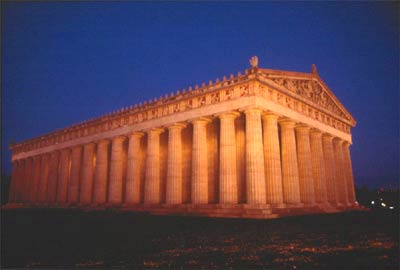
Weather wore down Nativity scene that lit up Centennial Park for 15 years
When we were children in the 1960s, our favorite holiday tradition was a visit to Centennial Park to see the Christmas display. The trip from Lewisburg to Nashville was so exciting for us just filled with bright lights, Christmas carols and a stop at the Krystal burger restaurant where we always ate a sackful! Could you furnish some information about the display? I remember it was composed of white statuettes and was placed beside the Parthenon.
It just wouldn't have been Christmas, Nashvillians and thousands of Middle Tennesseans of a certain age know, without a family visit to the dazzling spectacle that was the Nativity scene at the Parthenon.
Missing the display at Centennial Park was unthinkable for up to a million people annually some of the years of its holiday run, from 1953-67. The assemblage of biblical characters associated with Jesus' birth, angels, animals, sand dunes and palm trees created an exotic scene that started out huge and grew each year as new elements were added to the cast.
About 7,500 colorful light globes and a background of 33,000 specially made Italian lights that blink like stars added to the mystique.
All was bathed in brilliant white light at least until steadily alternating colors were introduced in 1955 against a backdrop of classical Greek architecture. Silent Night and other songs of the season blared from loudspeakers 8 a.m.-11 p.m. as spectators drove or walked past.
Fred Harvey Sr. (1898-1960), the Canadian-born founder of the former Nashville-based Harvey's department store chain, had the inspiration for this gift to the city of Nashville. It cost his business up to $250,000 over the years, in a period when that bought a lot more than today's nice house.
Planning took two years. The Italian-born sculptor Guido Rebechini, a graduate of art school at the University of Florence, was commissioned to create the figures in the display. The Chicago artist was said at the time to be best known for his life-size figure frieze in Montreal's Notre Dame Cathedral, as well as works in Bolivia and Argentina. In the late 1950s, he made a 6-foot bust of Thomas A. Edison.
Rebechini had help with the Nativity scene from Marian Jaulaski, described as his Polish student. Their work in the medium of alabaster-white celastic (a plastic-impregnated fabric) and hard rubber was completed at Sylvestri Art Manufacturing Co. in Chicago.
In 1963, a heavy snowfall covered the scene that stretched the length of the Parthenon. The snow enhanced its beauty but also allowed additional moisture to seep into the statues that included 45 humans and 78 animals.
Several of the figures were "fiberglassed" in 1964 "to add to their usefulness." The effort wasn't quite enough. Many began to disintegrate from the inside.
By 1968, the annual exposure to Nashville's fluctuating winter weather had weakened and eroded the statuary so much that the diorama wasn't fit to display outdoors. Some of its 12-foot-high angels were even being described as potential hazards to spectators if a strong wind were to catch their wings. The display was sold by the city to an advertising agency that placed it in a Cincinnati shopping center, where it was reportedly used indoors only two seasons before being discarded as irreparably worn out.
It lives on today in the memory of thousands of Tennesseans and in postcards, photos and art prints created over the years.
In its 15th and final season in 1967, the Harvey's Nativity scene at Centennial Park sparkled majestically one last time. Unknown to most of the thousands of spectators, the figures were being weakened beyond repair because of winter conditions. Department store owner Fred Harvey Jr. had assumed the ceremonial duty of lighting the display each year after his father's death.
Originally built for Tennessee's 1897 Centennial Exposition, this replica of the original Parthenon in Athens serves as a monument to what is considered the pinnacle of classical architecture. The plaster replicas of the Parthenon Marbles found in the Naos are direct casts of the original sculptures which adorned the pediments of the Athenian Parthenon, dating back to 438 B.C. The originals of these powerful fragments are housed in the British Museum in London.
The Parthenon also serves as the city of Nashville's art museum. The focus of the Parthenon's permanent collection is a group of 63 paintings by 19th and 20th century American artists donated by James M. Cowan. Additional gallery spaces provide a venue for a variety of temporary shows and exhibits.
To the generation who grew up here prior to WWII, the Centennial Park athletic field on 25th Avenue (where the Sportsplex is now situated) was the city's principal circus lot. There a spacious, level, and grassy expanse welcomed the big tent circuses year after year.
The John Robinson Circus may have been the first to play this lot in 1910. Forepaugh-Sells Bros. was there in 1911. During the flamboyant years of the American circus, all the great railroad shows came to Centennial Park: Sells-Floto, Al G. Barnes, Hagenbeck-Wallace, and Cole Bros., to name a few. Barnum & Bailey and Ringling both played there prior to their unification in 1919; and the combined show then played the park most years through 1947, when the park board decided to close Centennial to circuses.
During that era, the flatcars would unload at Kayne Avenue, the wagons being pulled up Division Street to the top of the hill and then over to West End. The zebras, camels, llamas, performing horses, and any elephants not needed for pulling wagons were unloaded from stock cars at the north end of the yards and led out Charlotte to 23rd Avenue, thence to the show grounds, going in the back way.
As you came on the lot from 25th, you would enter the "midway" area where the sideshows (with its congress of strange people) and numerous concession stands would be raised. Beyond that was the main entrance to the circus, which took you first into a long menagerie tent where you could walk cage to cage and from pen to corral viewing animals from the corners of the earth. I saw my first gorilla (the famous "Gargantua") here. The elephants might number from a dozen to forty, and it was not unusual to find giraffes, a rhino, and a hippo on display along with polar bears and other species not generally found in Nashville.
Working your way through the menagerie, you would find yourself in the big top, a mammoth canvas tent as long as a football field and seating several thousand. Here the actual circus performance took place, and it was always a good one. All the big circus stars played Centennial Park: Clyde Beatty (whom I still consider the greatest of the lion and tiger trainers), the Wallendas of the high wire, the Zacchinis with their mammoth cannon, the Riding Hannefords, and the famous sad-faced clown Emmett Kelly. Tom Mix was once here with Sells-Floto and Jack Dempsey came with Cole Bros.
But those days are over; dead and gone. Apparently more dead than I'd realized. We recently overheard an old timer telling a member of a younger generation about the circuses he'd seen at Centennial Park. The listener responded with, "Sir, you must be mistaken; there isn't a building at Centennial Park big enough for a circus."