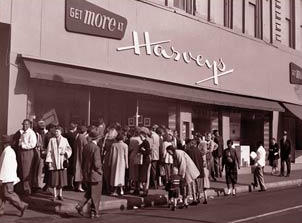
But then Harvey's supposedly had a operating Carousel on the top level of their store. (not the same as the 'Carousel Horses' that showed up there)
The store seemed unique that it could almost be called 'an amusement park'.
So I just add some 'excerpts' I have collected about Harvey's.
Weather wore down Nativity scene that lit up
Centennial Park for 15 years.When we were children in the 1960s, our favorite holiday tradition was a visit to
Centennial Park to see the Christmas display. The trip from Lewisburg to Nashville was so exciting for us � just filled with bright lights, Christmas carols and a stop at the Krystal burger restaurant where we always ate a sackful! Could you furnish some information about the display? I remember it was composed of white statuettes and was placed beside the Parthenon.It just wouldn't have been Christmas, Nashvillians and thousands of Middle Tennesseans of a certain age know, without a family visit to the dazzling spectacle that was the Nativity scene at the Parthenon.
Missing the display at
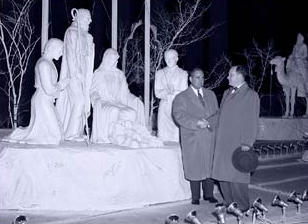
Centennial Park was unthinkable for up to a million people annually some of the years of its holiday run, from 1953-67. The assemblage of biblical characters associated with Jesus' birth, angels, animals, sand dunes and palm trees created an exotic scene that started out huge and grew each year as new elements were added to the cast.About 7,500 colorful light globes and a background of 33,000 ''specially made Italian lights that blink like stars'' added to the mystique.
All was bathed in brilliant white light � at least until steadily alternating colors were introduced in 1955 � against a backdrop of classical Greek architecture. Silent Night and other songs of the season blared from loudspeakers 8 a.m.-11 p.m. as spectators drove or walked past.
Fred Harvey Sr. (1898-1960), the Canadian-born founder of the former Nashville-based Harvey's department store chain, had the inspiration for this gift to the city of Nashville. It cost his business up to $250,000 over the years, in a period when that bought a lot more than today's nice house.
No sum could have purchased the public good will, and annual publicity, it created just in time for the prime retail season. Some eventually accused the scene of being overly kitschy or lacking in artistic merit. But as a reflection of its era, it was widely welcomed throughout the region as uniquely Nashville. Harvey got the idea for his display in 1950. He heard of a permanent Nativity scene near Innsbruck, Austria. On a European tour, he drove miles off the beaten track in the Alps to be inspired by it.
Planning took two years. The Italian-born sculptor Guido Rebechini, a graduate of art school at the University of Florence, was commissioned to create the figures in the display. The Chicago artist was said at the time to be best known for his life-size figure frieze in Montreal's Notre Dame Cathedral, as well as works in Bolivia and Argentina. In the late 1950s, he made a 6-foot bust of Thomas A. Edison.
Rebechini had help with the Nativity scene from Marian Jaulaski, described as his Polish student. Their work � in the medium of alabaster-white celastic (a plastic-impregnated fabric) and hard rubber � was completed at Sylvestri Art Manufacturing Co. in Chicago.
In 1963, a heavy snowfall covered the scene that stretched the length of the Parthenon. The snow enhanced its beauty but also allowed additional moisture to seep into the statues that included 45 humans and 78 animals.
Several of the figures were ''fiberglassed'' in 1964 ''to add to their usefulness.'' The effort wasn't quite enough. Many began to disintegrate from the inside.
By 1968, the annual exposure to Nashville's fluctuating winter weather had weakened and eroded the statuary so much that the diorama wasn't fit to display outdoors. Some of its 12-foot-high angels were even being described as potential hazards to spectators if a strong wind were to catch their wings.
The display was sold by the city to an advertising agency that placed it in a Cincinnati shopping center, where it was reportedly used indoors only two seasons before being discarded as irreparably worn out.
It lives on today in the memory of thousands of Tennesseans and in postcards, photos and art prints created over the years.
In its 15th and final season in 1967, the Harvey's Nativity scene at
Centennial Park sparkled majestically one last time. Unknown to most of the thousands of spectators, the figures were being weakened beyond repair because of winter conditions. Department store owner Fred Harvey Jr. had assumed the ceremonial duty of lighting the display each year after his father's death.