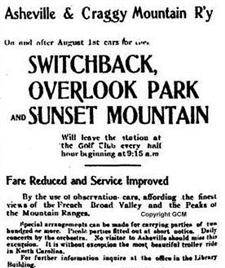
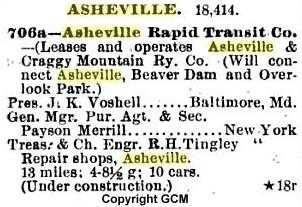
In the Asheville area I have tried to isolate parks from old records. It is difficult to isolate anything. It seems there was Sulfur Springs (possibly just a hotel and mineral springs), Overlook Park and Lake Tahkeeostee in Weaverville. Others ? Please excuse the text from Trolley Records but I will leave it here until something more is solved.


RICHARD S. HOWLAND. In 1904 Lewis Maddux, as receiver of the Asheville Street Railway Company, strung a trolley wire from Chestnut street along Charlotte street to what used to be known as the "Golf Club" and operated cars to that point by an arrangement with Mr. Gwyn. In 1901 Richard S. Howland, Esq., came from Providence, R. I., and bought property near the foot of Sunset mountain and erected a fine residence there. He acquired control of the Craggy Mountain Railway and completed it to the top of the mountain, where he erected a music and dance hall. He also obtained the right to operate his cars to the public square. The terminus of the railroad was called Overlook Park.
ASHEVILLE AND CRAGGY MOUNTAIN RAILWAY. On March 29, 1901, the city of
Asheville authorized the Craggy Railway Company to transfer its rights over Charlotte street to the reorganized Asheville Street Railroad Company. Mr. R. S. Howland operated this road to Overlook Park, on Sunset Mountain, several summers; but, by September, 1904, he had demonstrated to his own satisfaction that it could not be made to pay. In that month it was torn up and the rails and ties used to build a track from the Golf Club to Grace and thence to the French Broad river at Craggy Station on the Southern Railway, and the Weaver Power Company plant and dam, then but recently erected, and to the factory of the William Whittam Textile Company, which had been incorporated February 1, 1902. He also built a trestle across the French Broad river to the opposite bank, where the Southern Railway established a station called Craggy.
QUARRY. Meantime, however, not losing sight of the objective point of the Craggy Railway Company, Mr. Howland graded a roadbed and laid a track for a steam railroad from the new Music Hall at Overlook Park, to Locust Gap, a distance of about two miles, and opened a new quarry about a quarter of a mile from the Music Hall, with a track extending down to it. He also leased a part of the old James M. Smith property, in rear of the present Langren Hotel, where he established bins, and from which he sold all sorts of stone, bringing it down the mountain by a steam dummy engine, and hauling it through the streets of Asheville with a large electric motor engine. The ties and rails on the track to Locust Gap and to the new quarry were also taken up and placed on the railroad leading to Grace and Craggy Station. He also graded a traction road from near Locust Gap through the lands of J. W. Shartle, C. A. Webb and others to Craven Gap at the head of Beaver Dam creek, and thence to within half a mile of Bull Gap at the head of Ox creek on the North and Bull creek on the south. This road is to form a part of the projected automobile road from Asheville via Mitchell's Peak, and thence along the crest of the Blue Ridge to Blowing Rock. During this time Mr. Howland experimented with steam traction engines; but they were not satisfactory for the mountain roads.
ASHEVILLE LOOP LINE RAILWAY. Mr. Howland operated the railroad down to Craggy Station and to the Elk Mountain Cotton Mill till April, 1906, when he sold that portion of the railroad between New Bridge on the Burnsville road and Craggy Station to the Southern Railway, but continued to run cars from the Golf Club to New Bridge. The sale of the lower portion of this railroad also carried with it the corporate rights, etc., of the Asheville and Craggy Mountain Railroad Company, and it then became necessary to organize the Asheville Loop Line Railway to operate what was left of the Craggy Mountain Railway. This company, during the summer of 1906, leased from the Southern Railway that portion of the railway between New Bridge and Craggy Station and operated the entire line from the Golf Club to the river. The water impounded by the Weaver Power Company dam was called Lake Tahkeeostee, and proved quite an attraction to summer visitors who were in Asheville in great numbers during the season. The railroad paid a slight profit.
ASHEVILLE RAPID TRANSIT RAILROAD. During the fall of 1906 Messrs. Culver and Whittlesey, attorneys, and Mr. R. H. Tingley, civil engineer, of New York City, got control of the Loop Line railroad and determined to rebuild the track to the Music Hall on Sunset mountain. To do this they formed a new corporation called the Asheville Rapid Transit Company, December 18, 1906, and in March of 1907 obtained a franchise to build an electric railway from the corner of Water street and Patton avenue across North Main street, and thence along Merrimon avenue to a point near the Manor, and thence over private property to the Golf Club. In order to secure this concession from the city they deposited $1,000, to be forfeited in case they did not commence to build the railway into town by the following Septemher and complete it within a few months thereafter.
MERRIMON AVENUE LINE. These gentlemen secured enough money to reconstruct the track up the mountain to the Music Hall, which was in full operation by July 4, 1907, on which day two thousand passengers were transported over the new road. They continued to operate the road during the summer and opened a restaurant and moving picture show at Overlook Park. But the money they had expected to borrow for the completion of the railway into the city via Merrimon avenue could not be obtained, and they abandoned the enterprise, turning the property back to Mr. R. S. Howland in the spring of 1908. As there were several local debts due by the company the board of aldermen very considerable returned the $1,000 which had been deposited as a forfeit, upon the abandonment and release by the company of all rights on the streets, on condition be so applied. In June, 1908, Mr. R. S. Howland took charge of the company again; but the company not having paid the Asheville Electric Company for the power which had been furnished for some time previous the latter company refused to supply electric current for the operation of cars to Sunset mountain. An arrangement, however, was soon afterwards made for power to operate the cars from the Golf Club to New Bridge and this continued to be done till August 27, when the Rapid Transit Company was placed in the hands of a receiver. It was sold in December, 1908, to R. S. Howland and associates for $25,000. By an arrangement between Messrs. LaBarbe, Moale & Chiles and R. S. Howland the latter was to have the roadbed from the Golf Club to New Bridge and certain other property, and the former the track up the mountain and ten acres around Music Hall. This led to some litigation between these parties, which, however, was adjusted in 1911.
EAST TENNESSEE AND NORTH CAROLINA RAILROAD. During 1909 R. S. Howland built a trolley railroad from New Bridge to Weaverville, thus giving a continuous line from Grace to Weaverville. By a subsequent agreement with the Asheville Electric Company and the Asheville and East Tennessee Railroad Company, as this Weaverville railway company is called; under its charter, the latter has the right to operate its cars over the track of the former from Grace to Pack Square. This line passes over Merrimon avenue under a franchise granted the Asheville Electric Company by the city soon after its rights over that avenue had been abandoned by the Rapid Transit Company. Both the Merrimon Avenue line in the city and the railway from Grace to Weaverville have proven great conveniences to the public.
SUNSET MOUNTAIN RAILWAY COMPANY. Under this name LaBarbe, Moale and Chiles operated the road up Sunset mountain to Music Hall during the summer of 1910, but soon sold it to the E. W. Grove Park Company, who also bought about 300 acres on Sunset mountain from the Howlands. The track has been removed and the roadbed converted into an automobile road.
ASHEVILLE AND CRAGGY MOUNTAIN RAILWAY COMPANY. RECORDS, 1890-1941. Chartered in North Carolina in 1889 for the purpose of constructing a railroad from Asheville northeast to Craggy Mountain, North Carolina. Records include stockholders' and directors' minutes (1890-1941, 2 vols.); contracts, etc. (1905, 0.1 cu. ft.); annual reports (1924-41). Southern Railway Archives. Ms84-007.
CLICK HERE FOR PAGE INVOLVING SULFUR SPRINGS
CLICK HERE FOR PAGE INVOLVING LAKE TAHKEEOSTEE
CREDITS: Excerpts: Charlotte-Mecklenburg Historical Landmarks Commission-City of Asheville, North Carolina