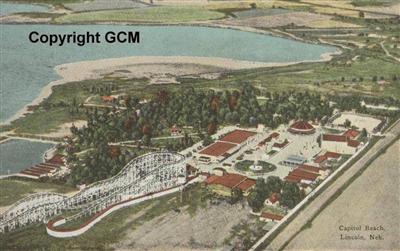
Nebraska's Salt Lake did not sit idle after it was abandoned by the short-lived salt industry. The test well dug by the state on the south shore of Salt Lake in 1887 continued to discharge its briny waters into the basin, and in 1895, a pair of entrepreneurs envisioned yet another path to riches by way of the salt basin. By diking the east end of the basin and diverting Oak Creek into it, permanent lake about a mile long and half as wide was created. Soon the water was plied by an excursion steamboat, and was lined with groves of trees, pavilions, bathhouses and restaurants. A Burlington Railroad spur carried visitors from Lincoln and the surrounding area to Nebraska's inland beach, and so it was named Burlington Beach.
Burlington Beach's crowds and the lake itself shriveled when the dike began to leak. In 1906, the development was revived under new ownership and a new name, Capital Beach revived under new ownership and a new name, Capital Beach (more commonly spelled Capitol Beach today). Less than a decade later, the "Coney Island of the West" was again on the decline and, against the advice of the Lincoln State Journal, the city of Lincoln decided against a proposal to purchase-for $100,000-875 acres encompassing Salt Lake as a city park.
Anyone with a spark of imagination cannot help viewing with enthusiasm the prospect of Capital Beach as a part of the city's park system. Here is Lincoln in the midst of a level plain, without rugged scenery and without a river. It seems like a special providence that at its very gates there should be a lake a mile long and a mile wide which could be made into a free vacation resort for the entire city. This lake, surrounded by trees and walks and drives, as it would be, and with ample park space on all sides is undoubtedly the city's greatest potential natural asset.
Lincoln State Journal, August 2, 1915.
In the 1920s, Capitol Beach was once again revived as a privately owned amusement park and saltwater resort. Until the early 1960s, the area flourished, featuring a saltwater swimming pool, dance hall and amusement park.
EXCERPTS: NebraskaLand Magazine
The Pearce Family Roller Coasters
The Pearce's have become somewhat of an enigma as most evidence of their coasters, both physical and photographic, has disappeared with time. In 1905 they built an Old Mill ride in Pennsylvania's Exposition Park. Later that year Fred Pearce moved to Fairyland Park in New Jersey. He built two coasters there, one unnamed and one called the Figure Eight. Fred ran the rides for five years and then decided to work solely in the field of ride design. The family built many coasters that were well known during their day. Robert Cartmell said they designed coasters at, "Ocean Park, in VA, the Big Dipper at Chippewa Lake, Ohio, a Racer at Revere Beach on Massachusetts, and coaster in Capitol Park, Lincoln, Nebraska." The most notable coaster was the Trip Through the Clouds at Riverview Park, Detroit, MI. The coaster had staggering statistics for 1915, 90-feet tall and over a mile in length. Fred Pearce's longest-lasting contribution to the amusement industry was the invention of pressure-treated, creosoted lumber. It lasted longer than untreated wood and allowed more coasters to be created for public consumption.
All of these families created rides and memories for millions of people. It unfortunate that historians are limited by a lack of records. Hopefully we will soon come across a more detailed accounting of their ride installations and advances in amusement park technology.
I have always wondered what happened to the carousel that was at Capitol Beach Amusement Park in Lincoln, Nebraska. It was so beautiful with horses that had huge cut glass jewels on their saddles and other wonderful animals.The park and particularly the carousel were such a part of Lincoln and of growing up in the 50's. I just hope it was saved.
Thank you for any information you might have regarding this wonderful piece.
....Mary...
EXCERPTS:UltimateCoaster.Com