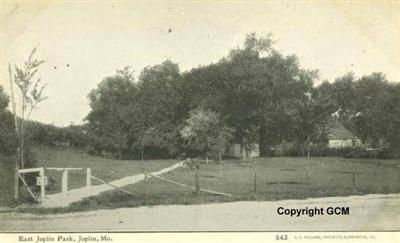
I include this Park because there is evidence it had 'amusement type attractions' during its history.
The ravine cradling Joplin Creek provided the impetus for the eventual founding of Joplin. In 1870, E.R. Moffet and his pal John B. Sergeant pitched their tents beside the creek, then dug a mine shaft and struck pay dirt. Rich with lead and zinc ore, the strip attracted a flurry of mining activity and two new towns were born. Joplin, on the east side of the creek, and Murphysburg on the west side, clashed bitterly before incorporating as one town, Joplin, in 1873. As Joplin grew, its major development took place on the west side of the creek, leaving East Joplin to fend for itself. Meanwhile, the Kansas City Southern Railroad laid tracks through the creek valley, cutting off East Joplin even further from the rest of the city. Brush, debris, and shacks littered the landscape along the "Kansas City Bottoms. " In 1893, the East Joplin Improvement Association worked to remedy the problem. The group graded ten miles of streets and laid six miles of sidewalks, then made plans to create a beautiful park. On March 31, 1906, William and Catherine Leckie donated four lots in the original townsite of Joplin for use as a public park. Two months later, James J. Cox donated another four and a half lots. East Joplin or Mineral Park kept growing, with further additions in 1910 from Picher Lead Company and from Mr. and Mrs. Charles Barrett, bringing the total acreage to fifteen. In 1912, the East Joplin Improvement Association enlarged the park again, extending it west through the Joplin Creek valley and south to Broadway. In 1919, City officials promised to clear out the "Bottoms" which the Joplin Globe termed "the only blackmark to the city." They paved a driveway that ran the entire length of the park and built a swimming pool and tennis courts. By 1926, the pretty twenty-acre Mineral Park was the one most accessible to the heart of Joplin. It featured picnic grounds, playground, rustic stone bridge, flower gardens, bandstand, refreshment stand, swimming pool and bathhouse.
CREDITS: EXCERPTS: Joplin City Library