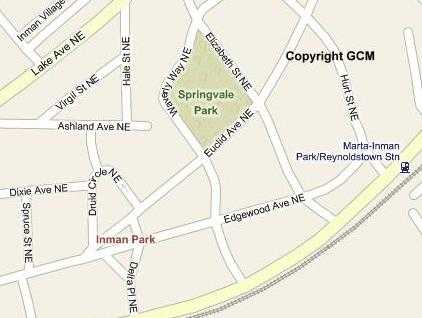
In 1903, Hurt hired the Olmsted Brothers firm to develop plans to enhance Springvale Park and the plant material list from their plans was used to recreate the park in recent years. The Olmsted firm was established by the Olmsted brother's father, Frederick Law Olmsted, who designed Central Park in New York City and Biltmore House and Gardens in Asheville, North Carolina.
Twenty years and three landscape architects since the neighborhood (under the leadership of Eileen Brown) first embarked on its task of restoring Springvale Park, the north end is finally complete. The restoration was funded through support of Festival activities along with matching grants from the National Trust for Historic Preservation, the State Historic Preservation Office and, most recently, a federal grant. Inman Park neighbors themselves have also contributed a great deal to the restoration of the park, with donations of their labor, professional skills and materials, including the installation of an irrigation system.
If you get a chance to stroll through the park, notice the 1889 stone wall at the west side of the lake and the Live Oak planted by Joel Hurt over 100 years ago.
During the Battle of Atlanta, the land which later became Inman Park was the center of many skirmishes. After the Civil War, Inman Park became Atlanta's first planned community and one of the nation's first garden suburbs. It was conceived and developed in the 1880s by entrepreneur Joel Hurt, who believed people should live in a countrylike atmosphere convenient to the central business district. To achieve this goal, he insisted on large lots, curving streets and open park areas throughout the neighborhood.
In 1889 he sold, at auction, land lots upon which gracious Victorian mansions were built. In the center of the new community Hurt set aside ten acres for Crystal Lake and Springvale Park, whose spacious grounds were landscaped with rare trees and shrubs, many of which were new varieties to Atlanta.
Never short of innovations, Hurt also formed one of the nation's first streetcar systems to provide rapid transit from Inman Park to downtown. The trolley route terminated at the Trolley Barn, which still stands today on Edgewood Avenue, just one block from the neighborhood's new MARTA station.
Inman Park was an immediate success, and many of Atlanta's most prominent citizens took up residence in the community. Families picnicked in beautiful Springvale Park and took leisurely strolls around Crystal Lake. Churches were active, and a strong community spirit prevailed. Those were sunny days for Inman Park. It was not only a good place to live, it was the place to live.
No one cared enough to protest when the city passed a blanket rezoning ordinance that brought the community to the lowest point in its decline. Crystal lake, clogged with garbage and uncut weeds, became a mosquito-ridden swamp and was drained. Joel Hurt's careful landscaping in Springvale Park went uncared for; again, no one protested when part of it was removed and paved over for the convenience of motorists from the outer edges of town who passed through Inman Park on their way to work. Junk cars lined the streets and sat in yards, and neglect was rampant.