Once upon an occasion, a trip to the Springs Recreation Park would allow for a ride on the only miniature steam driven railway in the world. On any given weekend, the Lancaster and Chester crew could be found operating the Lilliputian Branch of the railroad. In those days, the branch consisted of three locomotives, four passenger cars, two flat cars, and a caboose. There was more than one mile of rail with a turntable, a round house, a station, two sidetracks, a water tank and a tunnel. Thousands of children visited the park annually to ride the train. A portion of this train is already on display at the L&C Museum with the remaining portion undergoing renovations.

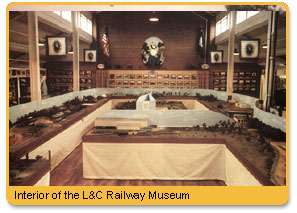
The highlight of the museum is a scale model replica of the original 29-mile route of the L&C. The railroad enthusiasts have taken on the responsibility of making exact replicas of every building and facility on the route, plus shrubs, trees and bodies of water.

Due to the diligence and hard work of several railroad buffs, including several L&C employees, the museum was established in the summer of 1995. Countless hours were spent preparing the site for the exhibition of hundreds of photographs depicting the railroad from the beginning to the present, railroad memorabilia, with information on the shortlines of the Palmetto state that have disappeared, and other relative artifacts. The museum opened for visitation in the fall of 1996.


Upon opening to the public in 1925, Springs Recreation Park was a happening place for the residents of Lancaster, South Carolina. However, recreation park seems to be too modest a term to use for Springs Park. By all accounts, it was more like an amusement park, complete with a skating rink, carousel, mini Ferris wheel, and bowling alley. All alongside its crown jewel: an Olympic-style swimming pool, half surrounded by an ancient Greek-style amphitheater, which purportedly was made to house 5,000 onlookers.

What remains of Springs Park is a weird site to stumble upon while trekking through the plush forest that lines the Fishing Creek Reservoir on the Catawba River. One may notice sheets of rusted metal or concrete slabs jutting out from beneath grass and shrubs, serving as little hints to visitors that there is more to the area than what first meets the eye.

The park closed in the summer of 1989 for unknown reasons. Though it's long past its heyday, Springs Park is still a site to behold. The original 30-foot diving platform sits crumpled in the pool's deep end, but the massive, concrete viewing stadium is still standing strong and likely will stay that way for the foreseeable future. A rusted foundation of the park’s skating rink juts out from the ground, and portions of the old mini golf course can be uncovered.

Gradually, the site has become reclaimed by nature since its closing in the late 80s, but one can still imagine what each of the ruins served to be.